What Fabric Weight Means in a Heavyweight T-Shirt
A T-shirt may look simple, but the way it feels, hangs and holds its shape is influenced by much more than colour or logo placement.
One of the most important factors is fabric weight.
For customers searching for a heavyweight T-shirt in the UK, terms such as 220 GSM, 280 GSM or 320 GSM may appear throughout product descriptions. Yet a larger number does not automatically mean a better garment.
Fabric weight matters, but it must work together with fibre quality, construction, fit and finishing.
Understanding that relationship makes it easier to recognise when a heavyweight T-shirt has been genuinely developed with substance—and when “heavyweight” is simply being used as a marketing word.
What does GSM mean?
GSM stands for grams per square metre.
It measures the weight of one square metre of fabric. In simple terms, a higher GSM usually means the material is denser or heavier.
A lightweight T-shirt may feel thin, airy and soft. A heavyweight T-shirt generally feels more substantial and structured.
However, GSM does not measure everything.
It does not automatically tell you:
- how soft the fabric feels;
- how strong the yarn is;
- whether the garment will shrink;
- whether the collar will keep its shape;
- how breathable it is;
- whether the stitching is secure;
- how well the T-shirt has been cut.
Two T-shirts with the same stated GSM can still feel completely different.
That difference comes from the quality of the cotton, the knitting method, the finishing process and the overall construction of the garment.
Why heavyweight T-shirts feel different
A heavyweight T-shirt usually has more physical presence than a standard lightweight tee.
The fabric may sit away from the body rather than falling flat against it. Sleeves can appear fuller, the chest can hold a cleaner shape and the hem may hang with greater control.
This can create a more refined silhouette.
Heavyweight fabric can also make a T-shirt feel less like a basic underlayer and more like a complete garment that can carry an outfit on its own.
That is especially important in premium streetwear, where the T-shirt is often expected to look considered without relying on excessive graphics.
The fabric itself becomes part of the design.
Structure without unnecessary stiffness
A good heavyweight T-shirt should feel substantial, but it should not feel like cardboard.
The purpose of added weight is not to make the garment uncomfortable. It is to create balance between structure and wearability.
A well-developed heavyweight fabric should allow the T-shirt to:
- maintain a defined silhouette;
- drape cleanly through the body;
- support the neckline;
- reduce excessive transparency;
- feel substantial in the hand;
- remain comfortable during movement.
If the material is too rigid, the garment may restrict movement or sit awkwardly on the body.
If it is too soft and loose, it may lose the structured appearance expected from heavyweight streetwear.
Premium development is found between those two extremes.
Cotton quality matters as much as weight
A high GSM number cannot compensate for poor-quality cotton.
Cotton quality is influenced by factors such as fibre length, yarn construction and how evenly the fabric has been knitted.
Better-quality cotton can feel smoother and more refined. It may also produce a cleaner surface for printing, embroidery or other branding techniques.
A premium heavyweight T-shirt should ideally feel:
- dense but comfortable;
- smooth rather than coarse;
- soft without feeling weak;
- structured without feeling restrictive;
- consistent across the entire garment.
The aim is not simply to use more material.
The aim is to use the right material well.
How fabric weight affects the silhouette
The weight of a T-shirt changes the way it behaves on the body.
A lighter T-shirt often follows the shape of the wearer more closely. It may move easily, but it can also cling, crease quickly or lose definition.
A heavyweight T-shirt can create a more controlled form.
It may produce:
- a cleaner shoulder line;
- fuller sleeves;
- a straighter fall through the torso;
- a more defined hem;
- greater separation from the body.
This does not mean every heavyweight T-shirt should be oversized.
The final appearance still depends on the pattern and proportions.
A regular-fit heavyweight T-shirt can look refined and structured. An oversized version can create a broader, more dramatic silhouette. Neither is automatically more premium.
What matters is whether the fabric weight supports the intended fit.
The importance of the neckline
The collar is one of the first areas where T-shirt quality becomes visible.
A strong neckline should sit neatly around the neck, stretch comfortably and recover after wear.
On a heavyweight T-shirt, the collar must be substantial enough to balance the body fabric. A thin or weak ribbed collar can make an otherwise premium garment feel unfinished.
Important details include:
- rib density;
- collar width;
- elasticity;
- recovery;
- stitching;
- reinforcement around the back neck.
A collar that twists, stretches or becomes loose too quickly can weaken the entire appearance of the T-shirt.
The neckline may be a small part of the garment, but it carries a great deal of responsibility.
Fit still matters more than the number
A high fabric weight will not rescue a poor pattern.
The shoulder width, sleeve shape, body length and chest room all affect how the T-shirt looks and feels.
A premium heavyweight T-shirt should be tested on the body rather than judged only while laid flat.
The wearer should be able to move comfortably without the fabric pulling across the shoulders or rising excessively at the waist.
The length must also be considered carefully.
If the body is too short, the T-shirt may lift when the arms are raised. If it is too long, it can lose its intended proportions and overwhelm the rest of the outfit.
Heavyweight fabric creates presence, but fit gives that presence direction.
Printing and embroidery on heavyweight fabric
A dense fabric can provide a strong base for branding, but the application method still needs to be carefully selected.
Printing can create a clean and controlled finish, particularly when the surface of the fabric is smooth.
Embroidery can add texture and depth, but it must be balanced with the weight and stretch of the material. Excessive stitch density may cause puckering or distortion.
The placement of branding also matters.
On a premium T-shirt, a logo should feel integrated into the design rather than added simply to fill empty space.
This may mean:
- a restrained chest wordmark;
- a carefully positioned crest;
- a larger back design;
- subtle sleeve detailing;
- tonal or contrasting application.
The strongest result is achieved when the fabric, fit and branding support one another.
Does heavier always mean more durable?
Not necessarily.
A heavier fabric may feel stronger, but durability depends on more than weight.
The garment must also have:
- secure seams;
- good-quality yarn;
- stable knitting;
- suitable finishing;
- tested shrinkage;
- colourfastness;
- correct care instructions.
A badly constructed heavyweight T-shirt can still twist, shrink or lose its shape.
Similarly, a lighter T-shirt made from excellent materials can perform well over time.
Weight is one indicator of substance—not a complete guarantee of quality.
Shrinkage and washing
Cotton garments may change after washing if the fabric has not been properly treated or tested.
This is particularly important with heavyweight T-shirts because even a small percentage of shrinkage can affect body length, sleeve length and overall fit.
A premium garment should be developed with washing behaviour in mind.
Customers should always follow the care label, but brands also have a responsibility to provide instructions that reflect the actual fabric.
Good care practices may include:
- washing at a low temperature;
- turning the garment inside out;
- using a gentle cycle;
- avoiding harsh detergents;
- reshaping while damp;
- air drying where appropriate;
- avoiding excessive heat.
Proper care helps protect the shape, surface and branding of the garment.
How to judge a heavyweight T-shirt online
Customers cannot physically feel the fabric before ordering online, so the product page should provide clear and useful information.
Look for:
- confirmed fabric composition;
- stated GSM where available;
- fit description;
- front and back photographs;
- close-up fabric images;
- collar details;
- model photography;
- care instructions;
- size measurements;
- transparent delivery and returns information.
A product should not rely only on words such as “luxury,” “premium” or “heavyweight.”
Those claims should be supported by detail.
The KROSSTOUCHE® Signature Heavyweight T-Shirt
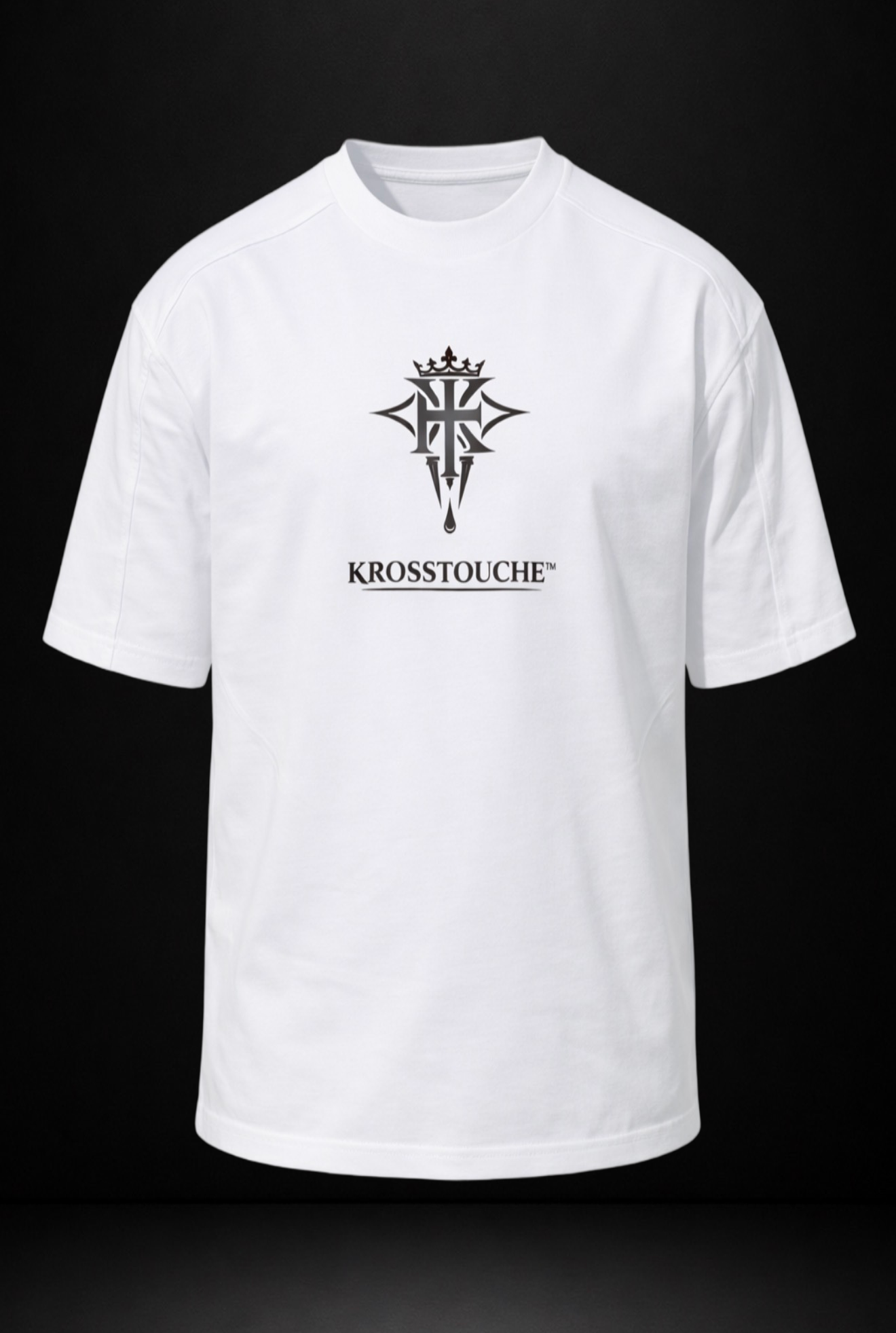
The KROSSTOUCHE® Signature Heavyweight T-Shirt — Optic White is designed to bring substance to an everyday essential.
Its purpose is not simply to be heavier than an ordinary T-shirt. The goal is to create a garment with presence, structure and versatility.
Optic white gives the piece a clean and deliberate appearance, while the KROSSTOUCHE® branding introduces contrast and identity.
The design is intended to work independently or as part of a wider KROSSTOUCHE® look.
It can be worn beneath a hoodie, paired with panelled joggers or styled as the central piece of a minimal outfit.
The strength of the garment should come from the relationship between fabric, silhouette and detail—not from decoration alone.
Heavyweight should mean considered
A heavyweight T-shirt should offer more than a large GSM number.
Its quality should be felt in the fabric, seen in the silhouette and supported by the construction.
The collar should hold. The shoulders should sit correctly. The body should fall with control. The branding should feel purposeful.
When those elements work together, the T-shirt becomes more than a basic layer.
It becomes a garment with its own presence.
Discover the KROSSTOUCHE® Signature Heavyweight T-Shirt in Optic White.

Written by AYODEJI ONADEKO